You’ve Never Seen Anything Like This: The Most Realistic Miniature Fire
Terrifying, destructive wildfires have swept across California. Homes are burning, along with gigantic ancient sequoias. Flames climb all the way to the treetops, while thick smoke churns below and drifts between the trunks. In the distance, the lights of fire engines flicker. It feels like a frame from a documentary about California wildfires—but in fact, what you’re looking at is a miniature, recreated with maximum realism to capture the tragedy of a forest fire. This museum diorama was handcrafted using a unique technique. So how did we pull it off?
A Fire Scene in 1:87 Scale
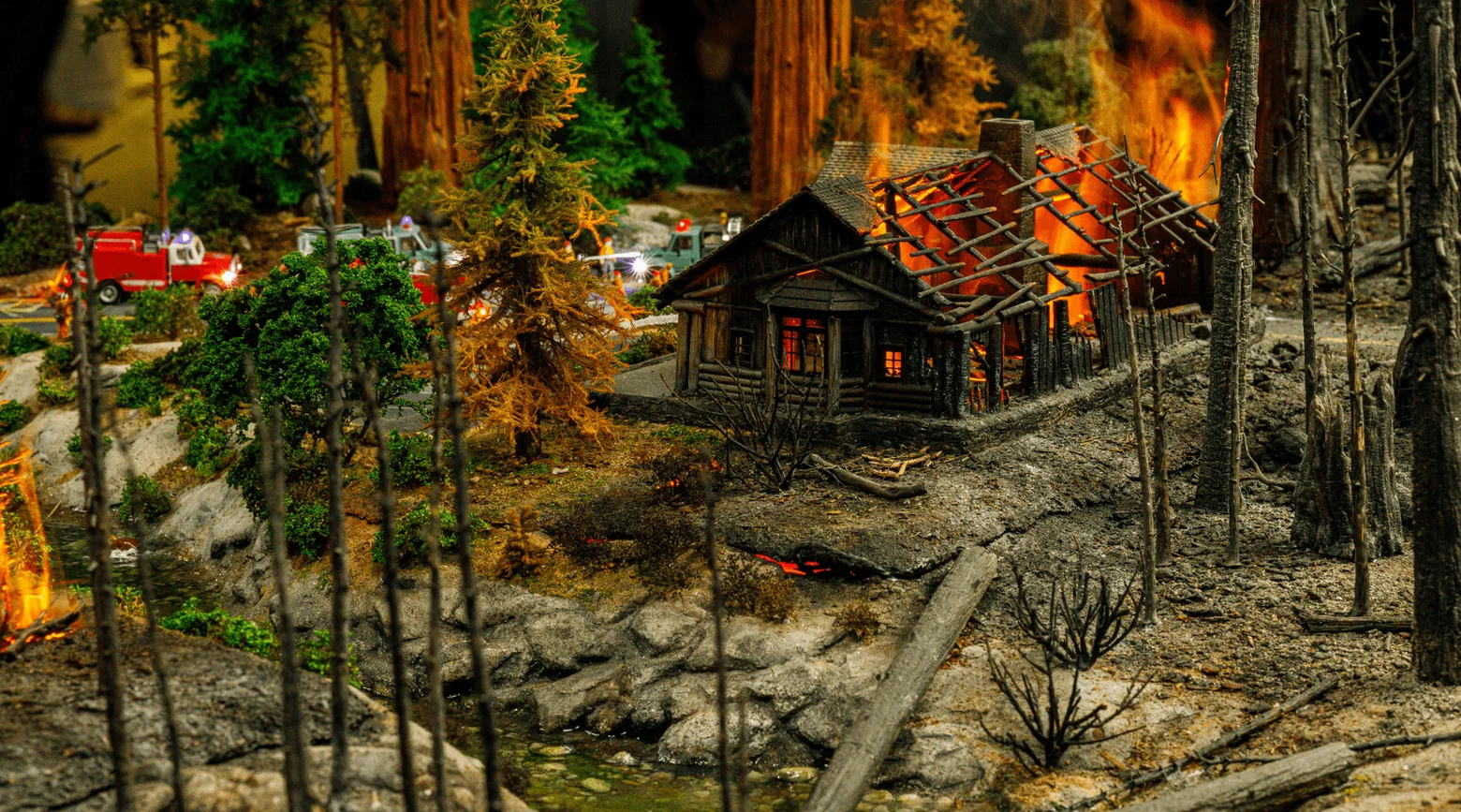
The model was created for a museum exhibition dedicated to nature and national parks. It’s not small: the physical size is 1.74 × 1.5 meters, and the scale is 1:87. This is a popular “railroad” scale widely used for architectural dioramas and museum models. In this scale, for example, a person 1.8 meters tall looks like a figure about 2 centimeters high. That means giant sequoias reaching nearly 90 meters become trees almost a meter tall in the model! This level of reduction makes it possible to show an entire fragment of forest while still keeping it compact enough for a museum.
The composition was inspired by the devastating wildfires in California, where sequoias—famous long-lived giants, some more than 1,500 years old—have burned. Normally, their thick bark protects them from fire, but under extreme conditions even these “immortals” of nature can’t withstand it. For example, one of the 2020 fires was so powerful that flames burned foliage even at heights above 91 meters. That’s exactly the scale of catastrophe we wanted to convey: fire raging along the full height of the trees, emphasizing the drama of what’s happening.

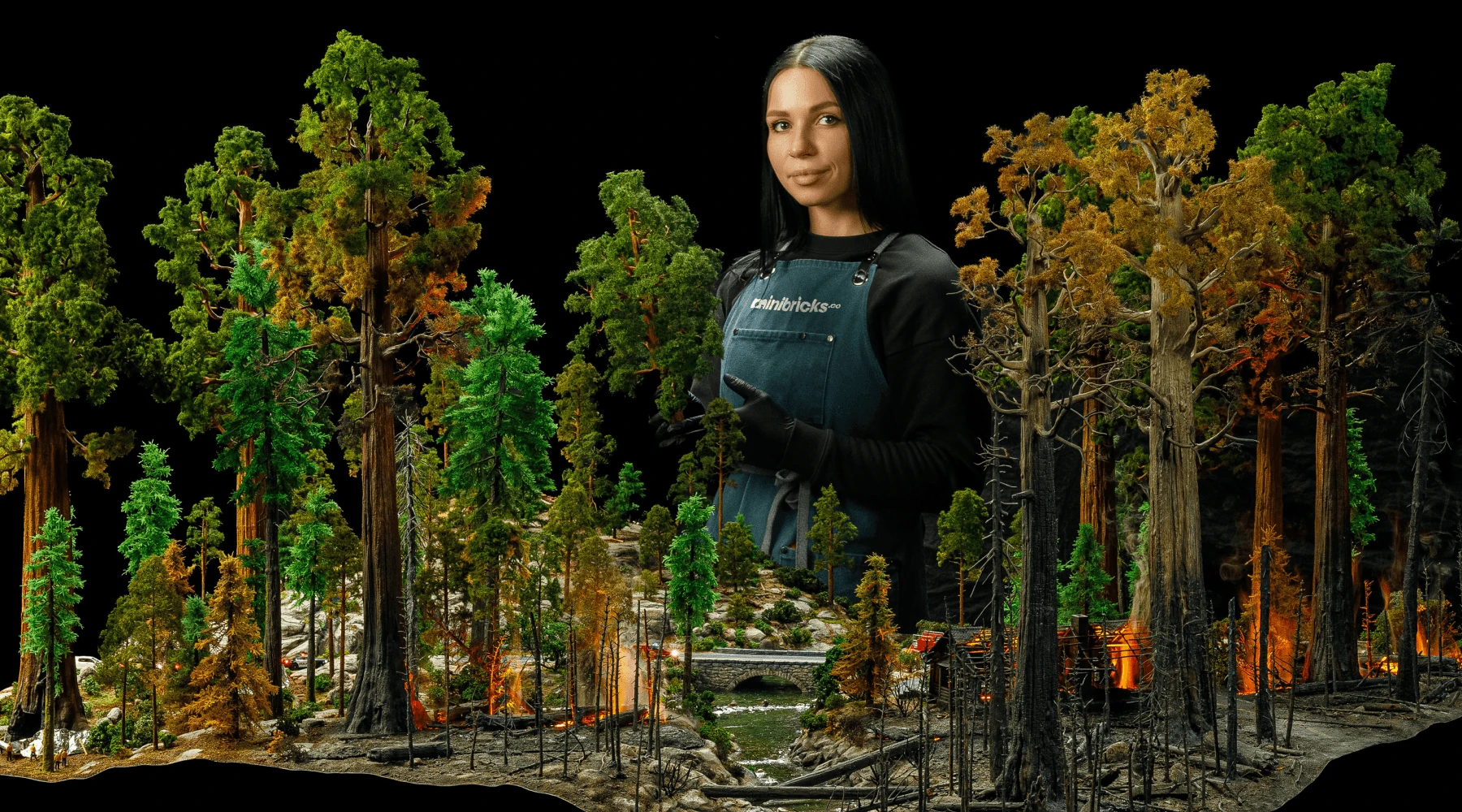
In the photo: a general view of the forest fire diorama. Giant sequoias dominate the landscape—both healthy green crowns and scorched trees are visible. In the foreground you can see charred trunks, while deeper in the model the flames blaze and emergency vehicles are at work.
The entire landscape—everything from the terrain to the tiniest trees—was made completely by hand. We grew this miniature forest from scratch. To create believable foliage, we used airbrushed painting on the crowns, allowing us to capture natural shades and smooth color transitions. The trunks, printed on a 3D printer, are also refined by hand by our artists—to reflect the unique texture of each tree’s bark, as well as burned areas.
Interactivity for Maximum Realism
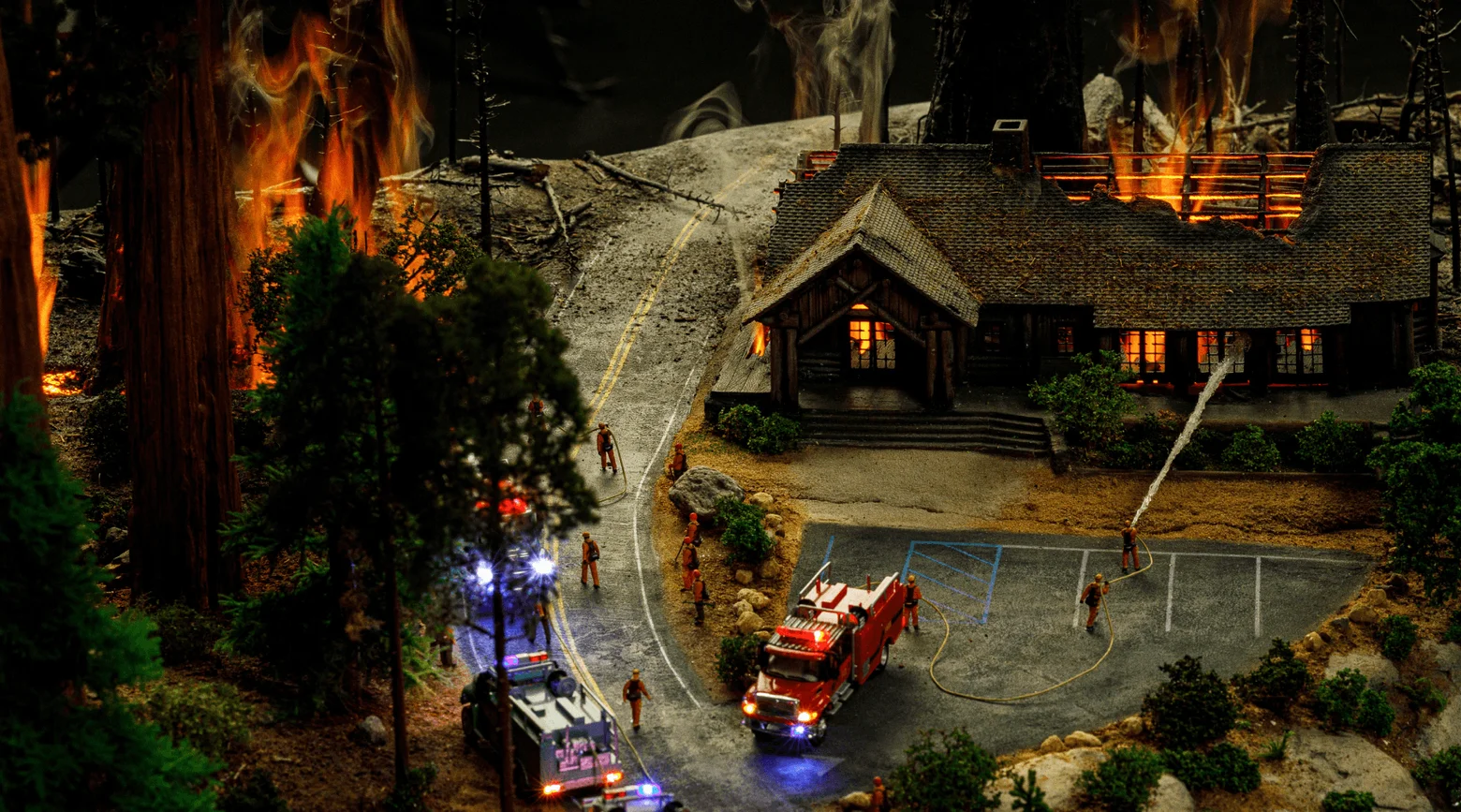
The main feature of this model is its interactivity, which makes the scene truly come alive. And of course, the fire is the star. Instead of simply hiding a blinking lightbulb inside a tree, we took a different approach. Compact Dimplex Opti-Myst Cassette 400 NH electric fireplaces are installed inside the diorama, using ultrasonic mist technology. Combined with LED lighting, these devices create an exceptionally convincing illusion of flames and smoke. Our engineers modified the system further by adding an automatic water supply to these mini fireplaces, so they can continuously generate “smoke”—a fine water mist. With focused lighting on the ignition points, the result exceeded all expectations. The flames in the model look unsettlingly real: they flicker, glow from within, and lift a light haze. You almost want to check whether the “fire” feels warm with all that intensity!
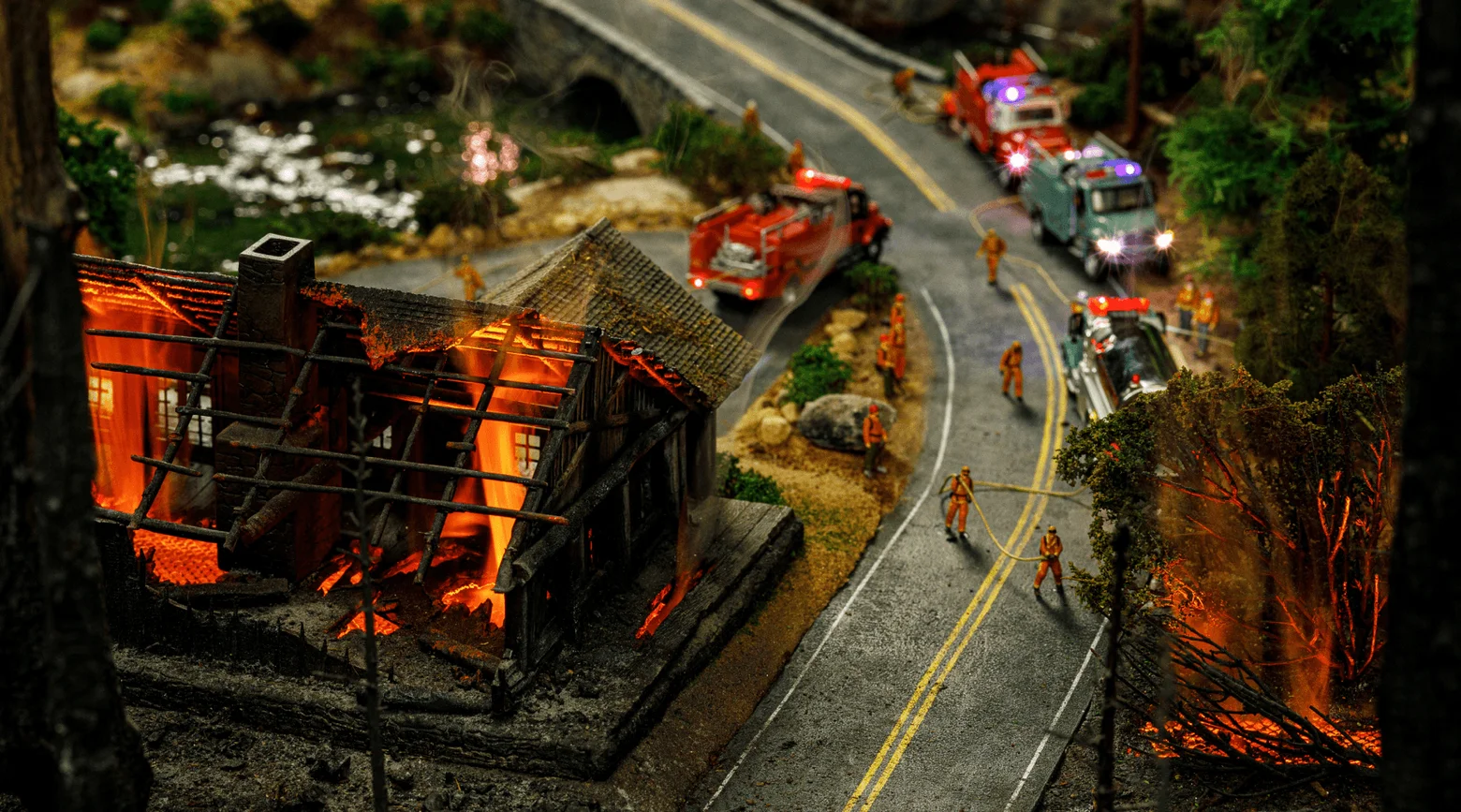
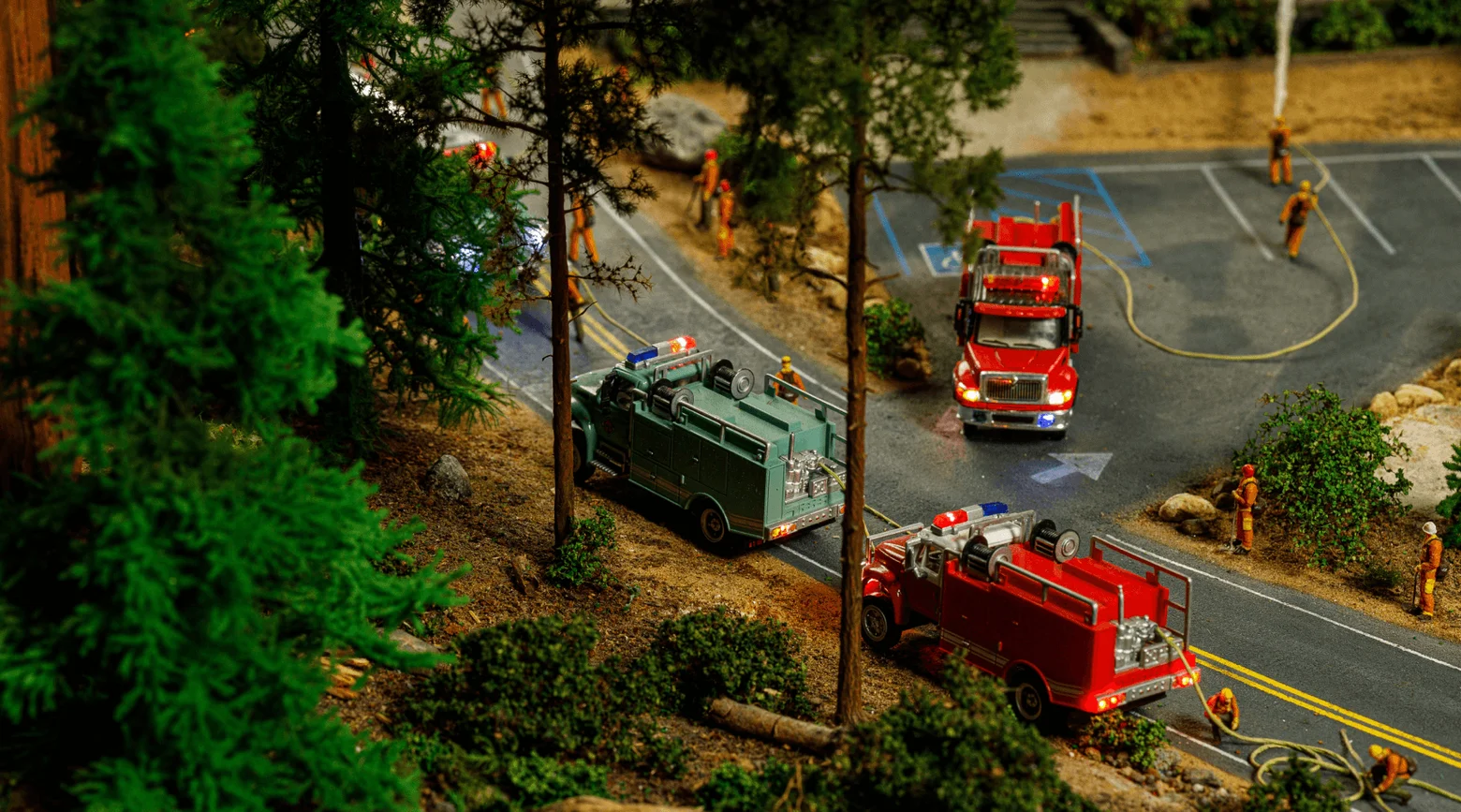
But fire isn’t the only dynamic element. Around the burning forest, emergency services are in full motion. Fire crews race along the road toward the incident, and their flashing lights cast blue and red reflections onto the trees. Each emergency vehicle has its own rhythm of flashing beacons. The light signals on different models are programmed differently: some blink more frequently, others less; some alternate colors. Because of this, the convoy doesn’t look toy-like—on the contrary, each vehicle seems to have a life of its own, just like in reality.
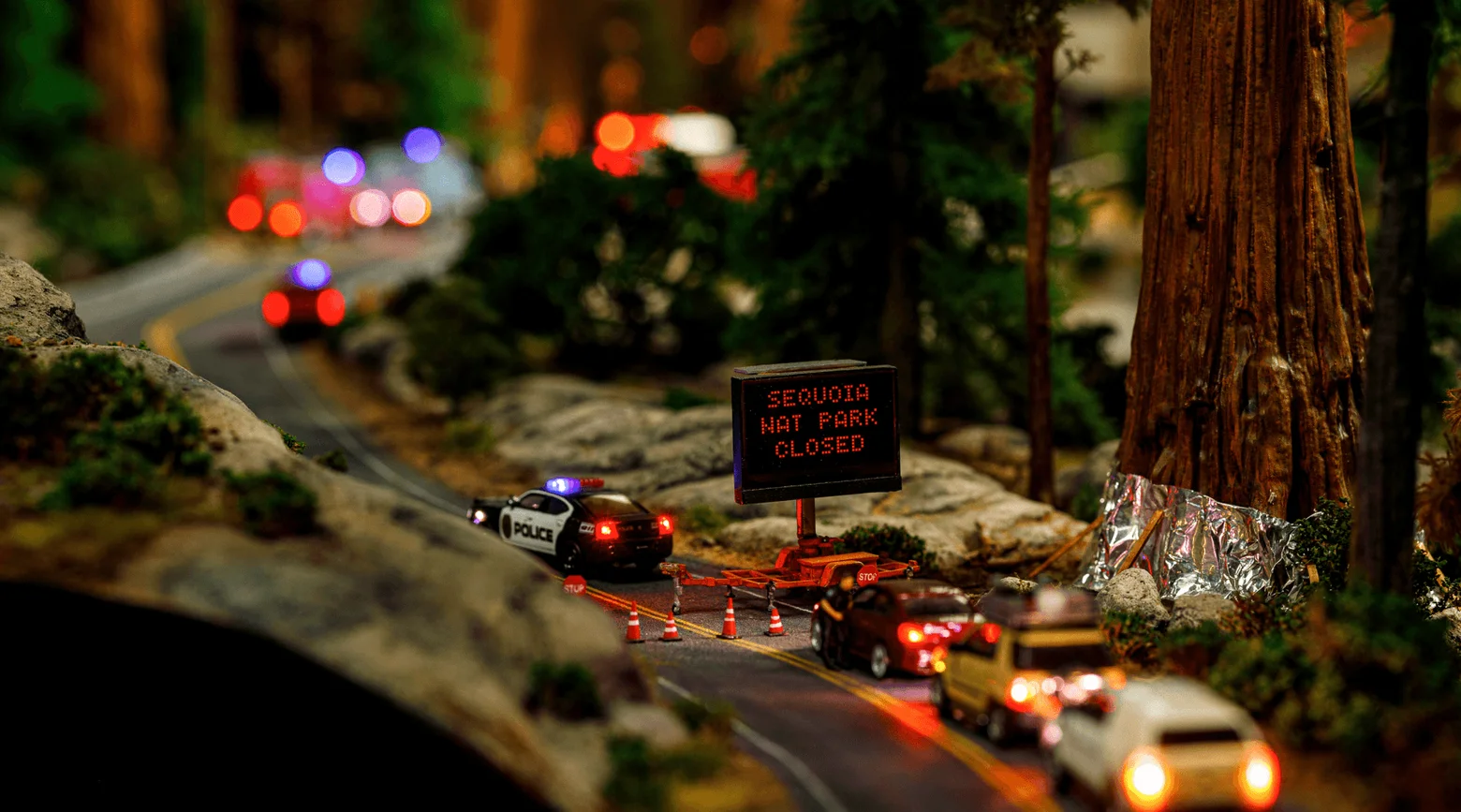
On the roadside you can spot an electronic signboard with a scrolling message. This tiny working screen displays changing text—exactly like the signs used in national parks during disasters to warn visitors. It’s an easy detail to miss at first glance, but it adds a huge amount of credibility: it feels as if there’s an entire world beyond the diorama, with its own infrastructure and people.
We deliberately avoided generic, off-the-shelf solutions and aimed for maximum realism. For comparison, other studios often simulate fire with a blinking LED and a smoke machine—resulting in a flat, unconvincing effect. The same goes for trees: most often they’re bought ready-made from model-making shops, so they look similar and the species aren’t distinguishable. We create our trees from scratch, using our own 3D printing and an original technique for building the crowns. The naturalistic sequoias in our model amplify the drama of the entire scene.
In the end, it became more than just a model—it’s a true atmospheric diorama that’s impossible to look away from. Standing in front of it, viewers feel as if they’re right at the edge of a raging forest: any second now, they expect to smell smoke and hear the crackle of burning branches.
So yes—even a natural disaster can be recreated in miniature in a way that gives you goosebumps, while still allowing you to safely examine every detail of the spectacle.
Thank you for reading.
If you found this useful, please support the author.
Tip the author